
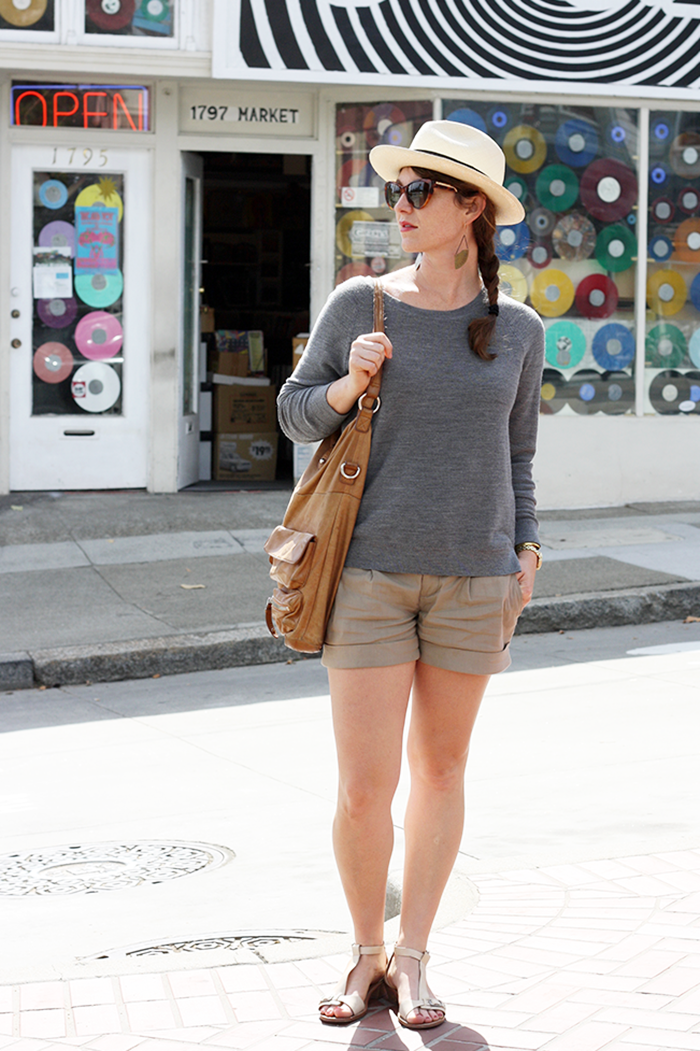
Groovin' on a Sunday afternoon


I'm keeping it simple this weekend with Everlane's Seed Stitch Raglan sweater, which arrived at my doorstep in under an hour through the company's 1-hour San Francisco delivery service. That, Grooves Vinyl, and these sunny Autumn days are just a few reasons to love our little city.
Everlane's Open Studio... and a Drink or Two

A couple of weeks ago, Jon and I had the pleasure of visiting Everlane's open studio, where we browsed through their men and women's basics and got a sneak peek at their Spring collection. Everlane's bright, minimalist space is a perfect reflection of their brand; like their neutral tees, button-ups, and sweaters, this crisp backdrop showcased the style of each attendee. Skinny jeans and animal-print clogs, cotton sweaters and red lipstick, rolled-up oxfords and ink -- this was the aesthetic of the day.
After a couple of cocktails courtesy of the event's stellar bartenders, we wandered over to The Homestead which (surprise) was nearly empty at 1pm on a Saturday. Rain, whiskey, a crochet beret, and a fleeting sense that we could live like this forever... it makes me want to wax poetic. How about some pictures instead?


Featured above is my much-loved Krochet Kids knit cap.
Smug alert: a quick word on the privilege of "ethical" style
I was Christmas shopping this year in the upscale neighborhood of Noe Valley when I stumbled upon Mill Mercantile, a women’s clothing store that sells beautifully crafted basics. As I browsed though their Breton sweaters, hand-died stoles, and Italian-made wool jackets, I was struck by two equally powerful emotions:
1. Empowerment at the realization that, for the first time in my life, I could drop $200 on a sweater
2. Guilt, with the force of a thousand rosaries
A little context: I’ve never been poor, in that I’ve never experienced food insecurity or homelessness, and have never had to rely on public assistance. I do know what it’s like to live paycheck to paycheck, and to mentally calculate, at the mercy of an impatient cashier, whether or not that extra gallon of soymilk is going to overdraw my account. I know what it’s like to have to choose between paying rent or making my student loan payment, and the late fees and poor credit that result. I know what it’s like to sit among a group of women wearing designer blazers and feel completely inferior – because somehow my failure to dress professionally is a reflection on my initiative or success.
But eventually, I got lucky. I found work that allows me to live in one of the most expensive cities in the country and not spend two thirds of my income on rent (albeit with rent control). My husband and I both work and don’t have children, providing us with a healthy amount of disposable income. In other words, I am living a pretty privileged life. Although I know that it could all go away at any moment, for now I've got my American dream. Do I have more of a right to it than anyone else with the same education or work ethic? Of course not; I simply got lucky.
I reveal all of this because when I link to a pair of expensive shoes or post pictures of myself wearing a $200 dollar sweater, I am acutely aware of the fact that many people in my neighborhood (and the people getting Ellis Act-ed out of the neighborhood) can’t afford to shop at the boutiques sprouting up in their midst. As much as I want to support local retailers, artists, and designers, I can't help but mutter to myself every time I walk down Valencia Street, "great, more succulent atriums and minimalist baby toys.”
This doesn’t mean that I won’t shop there. I’m ecstatic that I can finally afford to invest in beautiful clothing that I will keep for years, and that I can contribute to San Francisco's manufacturing renaissance. I love that I can participate in an economy that I believe in: one that values quality construction, responsibly sourced materials, and the creation of local jobs in the apparel industry.
But I admit that this philosophy and the terms that go along with it (responsible, ethical, conscientious) are steeped in judgment and self-congratulation. They imply that anyone who doesn’t or can’t afford to shop sustainably is unethical, irresponsible... ignorant. It’s no wonder that the language of sustainability is a defining attribute of the yuppie-hipster (yipster!) stereotype. As that legendary South Park episode so aptly points out, we run the risk of being suffocated by our own smug.
I don’t have a solution to the growing income divide in the Mission and throughout San Francisco, nor do I know exactly how I feel about gentrification as a whole (that requires another, much more nuanced conversation). But as the author of a sustainable fashion blog and the owner of several succulents, I felt compelled to acknowledge my privilege and the inherent flaws in the language I use here.
My next goal is to outline how ethical style can be achieved at a range of income levels, and to continue to profile low-cost options like thrifted clothing, refashions, and DIY projects alongside more expensive items. So bear with me while I search for my place in the ethical fashion world, and I encourage you to share your own struggles and successes in navigating this complicated territory.