
The Ethical Wardrobe, Part II: Who Made My Clothes?

But it certainly hasn't been a cakewalk. It took me three years to compile a modest list of ethical fashion brands. I've been floored by how expensive some sustainable options are. I've been frustrated with the elitism inherent in the ethical lexicon. And I still feel like a total weirdo every time I walk into a store and proceed to turn everything inside out to see where it was made.
In fact for many people cost, confusion, time restraints, and even embarrassment can be major barriers to making more ethical choices. But the wonderful thing about the ethical fashion movement is that it allows you to start small. You don't need to overhaul your closet or become a minimalist or spend $360 on a fair trade scarf (although don't let me discourage you, darling). All you need to do is start asking questions, one of the most important of which is...
Who made my clothes?
It’s simple, but putting a face to the things we interact with everyday – whether it’s the food we eat, the clothes we wear, or the devices we're attached to – can help keep us accountable. During my talk, I brought in several pieces of clothing and accessories from my own closet, which included Shinola, Horween Leather Company, Mata Traders, Everlane, Krochet Kids, and BCBG. I then asked the audience to think for a minute about who they thought might have made them. What were their lives like? How much were they paid? Did they get to design the garments themselves, take pride and ownership of their work? After a brief discussion I shared what I knew about each piece based on the information the companies provided:

The first five companies are all ones I consider to be ethical or sustainable for a variety of reasons. There are a lot of different ways to define "ethical" (which I'll go into in more detail later), but the Ethical Fashion Forum's definition is a good place to start. EFF describes a "triple bottom line" necessary to make a business truly sustainable: social, environmental, and commercial responsibility. In other words, truly ethical fashion goes beyond simply doing no harm; it actively reduces poverty, creates sustainable economies, lessens and counteracts environmental degradation, and meets an existing market demand. You can read more about it here.
The companies profiled above satisfy these parameters to varying degrees, but to put it even more simply, they allow me to answer that most-important question, who made my clothes? Because these companies have transparent supply chains, I know who made my favorite alpaca scarf, I know that she was fairly compensated for her work, and I even know that she plans to major in a technical field and own her own home. These are purchases I can feel good about, and companies that I am happy to support.
But these companies are the exception, not the rule. A lot of items in my closet come from companies like BCBG. You know, the one with the dramatic question mark; the one that reads UNKNOWN. I wish I could tell you that whoever made my favorite wool coat in China wasn't a slave laborer or under the age of 14, but all I can really do is make assumptions about what working conditions are like in these factories based on vague corporate social responsibly statements.
In some cases, working conditions might be fair, and even enable employees to support their families, rise from poverty, and live better lives than their parents. NPR's Planet Money Makes a T-Shirt has a beautifully nuanced video that follows garment workers in India and Columbia and illustrates how wildly wages, working conditions, and and social mobility can vary from country to country.
And then of course, we have Rena Plaza. Which makes all this not-knowing or kind-of knowing not ok.
And remember, ethical fashion is more than simply not doing harm, it's about making people's lives better. So even if a company claims it doesn't condone slave or child labor, or pollute the environment all that much, it's not inherently ethical. I'd rather know that my purchases are actively making the world just a little more fair.
So, who gets my money?
As Jess of Notes From a Thoughtful Life points out, there's no wrong or right way to approach ethical shopping. Which companies you decide to support will depend on the ethical issues you feel most strongly about. If you're vegan or vegetarian, you might want to focus on cruelty-free or animal-free products. If you're keen on bringing manufacturing back to the United States, you might want to buy American-made. If you're foremost an environmentalist, you'll probably prioritize brands that have zero-waste policies or minimal environmental impact. Ideally, an ethical fashion brand will have several ethical traits, but my focus had always been on humans (how can I make sure my purchases didn't hurt anyone along the way?). So I usually prioritize fair trade or made in the USA options over something that's simply vegan or "eco-friendly."
As I mentioned in my previous post, fashion is a big part of our identity, and inherently emotional. Clothes can mean joy, pride, celebration, dignity, and self-expression. They can mean enough money to feed your family, and prosperity for your community. They can also mean shame, struggle, abuse, even death. So when we vote with our dollars, let’s vote for joy.
I'll be following up with two more posts: one that explores the definition of "ethical" more deeply, and another that talks about how to make your sewing practice more sustainable. In the meantime, tell me about your own experiences with ethical shopping in the comments. What are the biggest hurdles you face when making more conscientious choices?
Scarf Weather


It may not be quite cold enough for a jacket and tights, but there's finally that Autumn nip in the air... and I'll take any excuse to break out my impossibly soft Krochet Kids scarf. Seriously, every time I wrap that alpaca wool around my neck, I want to curl up on the couch, drink a chai tea, and take a nap. Here's to lazy weekends, wood burning stoves, and dreams of winter. I'm ready.
Everlane's Open Studio... and a Drink or Two

A couple of weeks ago, Jon and I had the pleasure of visiting Everlane's open studio, where we browsed through their men and women's basics and got a sneak peek at their Spring collection. Everlane's bright, minimalist space is a perfect reflection of their brand; like their neutral tees, button-ups, and sweaters, this crisp backdrop showcased the style of each attendee. Skinny jeans and animal-print clogs, cotton sweaters and red lipstick, rolled-up oxfords and ink -- this was the aesthetic of the day.
After a couple of cocktails courtesy of the event's stellar bartenders, we wandered over to The Homestead which (surprise) was nearly empty at 1pm on a Saturday. Rain, whiskey, a crochet beret, and a fleeting sense that we could live like this forever... it makes me want to wax poetic. How about some pictures instead?


Featured above is my much-loved Krochet Kids knit cap.
Chula Lane
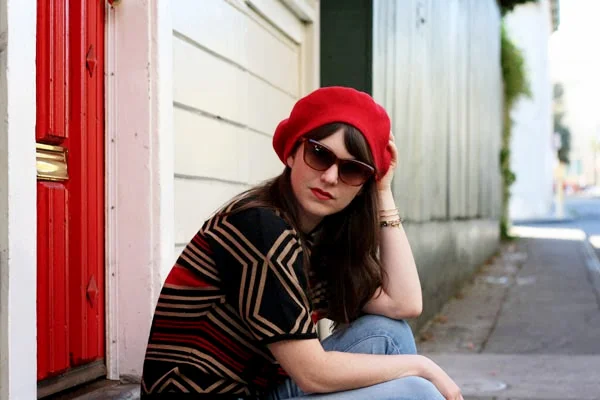


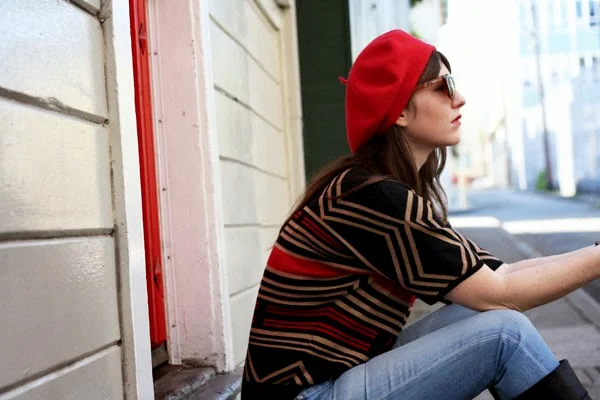
Thank you, resident of Chula Lane, for letting me use your font door and geraniums as a backdrop (you weren't home, so I'm assuming this was ok). Featured here are some of the most-loved pieces in my wardrobe, hailing from the good ol' USA and around the world:
Merino wool sweater from Pendleton's Portland Collection. Pendleton, the Oregon-based company with origins dating back to 1863, is bringing production back to the U.S. with its Portland Collection, a line of women's and men's apparel, accessories, and blankets designed and manufactured in its namesake city. And this sweater is simply magical; every time I put in on I swear I catch a whiff of wood burning stoves and hear echos of the Decemberists.
Krochet Kids alpaca scarf. Made in Peru by Fiorella Pereda, this Krochet Kids scarf kept me warm all through California's cold snap. Now, if we could just get some rain...
TOMS Kitty sunglasses in tortoise. So as to solidify my love of TOMS and its new business model, I finally bucked up and bought my first pair of fancy sunglasses. They're big, well crafted, and cooler than cool.
Cuff bracelet by Gorjana. My parents gave me this very special piece of jewelry for Christmas. It's the first piece I've owned by Gorjana, a socially conscious jewelry and accessories brand headquartered in Laguna Beach.
Adriano Goldschmeid jeans. Made in LA; I've had these jeans for over four years and they still look fantastic.
American Apparel red wool beret. Made in LA; one of my all-time favorite accessories.
Photos by Jonathan Meyer (husband, works for free).
How TOMS is Getting it Right
After owning a very durable, comfortable pair of their canvas loafers for over a year now, I can legitimately say I like TOMS' product, not just their mission. And now that the company is opening manufacturing centers in developing countries and using their strong market presence to promote other for-benefit brands, I'm also a fan of the way they do business. In my book, TOMS is getting it right in the ethical fashion world by:
1. Turning criticism into opportunity
TOMS debuted with a simple but novel business model: sell inexpensive canvas shoes and for each pair sold, donate a pair to a child in need. As TOMS' origin story describes, Blake Mycoski came up with this business idea when he traveled through some of the poorest villages in Argentina and noticed that most of the children there weren't wearing shoes. He then redesigned the traditional Argentine alpargata, marketed it to westerners, and in turn provided the world's poorest communities with footwear.
The problem was, the communities being targeted didn't just need shoes -- they needed jobs. Critics like Cheryl Davenport of Mission Measurement argued that TOMS' well-intentioned model was “little more than a short-term fix in a system in need of long-term, multi-faceted economic development, health, sanitation, and education solutions.” She pointed out that that TOMS’ success was hinged on western consumers’ need to “do good” without really taking the time to understand the needs of developing countries. If TOMS was to have a lasting impact on global poverty, she posed, it needed to invest in the communities it was supporting and provide viable economic opportunities -- to " create a solution, not a band-aid."
In turn, TOMS focused their efforts on producing shoes in the countries that they support. Currently, they have factories Ethiopia, Kenya, Argentina, and China, with the goal of producing one third of their shoes in the regions where they give them within three years. And in September at the Clinton Global Initiative Annual Meeting in New York City, Mycoskie announced that TOMS will open a manufacturing center in Haiti in January 2014 as a part of an ongoing partnership with the Haiti Artist Collective.
In Haiti, TOMShas made a five-year commitment to produce millions of shoes in a 10,000-square-foot factory in Port-au-Prinace to help foster a "responsible, sustainable" Haitian shoe industry. “By making such a strong commitment and business investment," Mycoskie says, "we hope to inspire other companies in the fashion and footwear industries to follow suit.”
It will be interesting to see what impact such investment has on the economies of these countries. If it does in fact create a significant difference, TOMS can serve as a model for other like-minded companies.
2. Using their influence to grown an industry
Though a combination of excellent marketing, ample press, and probably a good amount of luck, TOMS became a household name in both fringe and mainstream markets. And with the recent launch of TOMS Marketplace, they are using their influence to promote other brands with similar social purposes.
As of its launch last week, the marketplace features over 200 products from more than 30 companies and charities. Krochet Kids, a knitwear line that provides women in northern Uganda and Peru with a pathway out of poverty, is among the brands available. As a recent New York Times feature reported, TOMS chose which brands to carry based on a number of different for-benefit traits – from the “one for one” model they pioneered to companies like Krochet Kids that help build community infrastructure. As Mycoskie described, the real question was “'does this company really have a mission of improving people’s lives built into its business model?’”
It’s a standard that all ethical companies must be held to. More than being socially conscious, for-benefit companies must have the soul of a charity and the savvy of a for-profit. No easy feat, but I’m excited to see what TOMS and their brethren will accomplish in the coming years.