
The Great Closet Overhaul: Part One
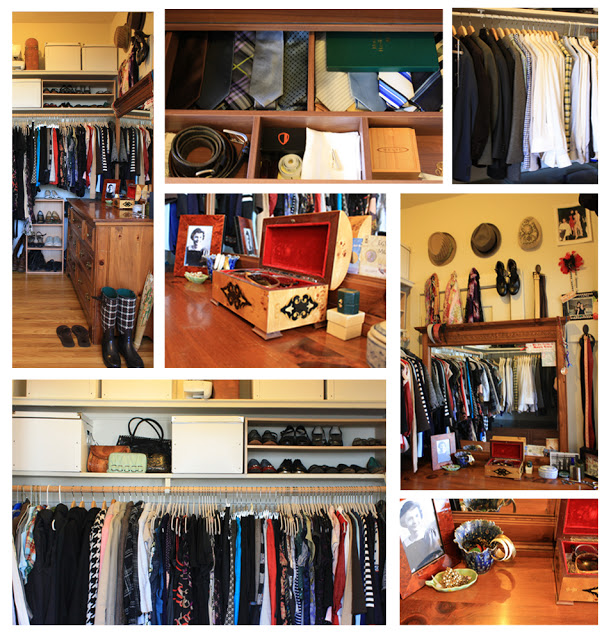
Just for a bit of context, here's what the ol' closet looked like before:

Ok, so I probably shot it at its most pitiful. Still, the lack of hanger space, drawers, and streamlined storage made it hard to find a damn thing in there. Which lead me to whine "I hate all of my cloooooothes!" consistently enough to convince my finance to help me reorganize. And oh, did we.
I don't feel that a full on narrative is necessary here (let's just say it involved a lot of sneezing, toe-stubbing, and screams of "f--king IKEA and your shitty f--king instructions!"). However, I can offer a few words of advice:
1. If you don't have enough drawers, buy a dresser or two. There are only so many things you can hang, and folding your clothes and stacking on shelving only leads to it falling off/ looking messy.
2. Invest in uniform storage containers. I know it sounds anal retentive, but the consistency of all-white boxes (or all pink, or all polka-dot, or whatever strikes your fancy) creates important visual cues. In other words, when you're looking for something to wear, your eyes aren't drawn to all the oddly-shaped moving boxes/ milk crates/ Trader Joe's bags full of old clothes and can instead focus on what's actually hanging in front of you. Trust me, it helps.
3. Invest in slimline hangers, preferably felt-lined. Not only will they maximize your hanging space, they're also just prettier. Which makes your clothes look prettier. And your clothes deserve to feel pretty.
4. Before deciding what to keep and what to get rid of, wash, iron, and hang up everything you own. I know it's a lot of work, but I ended up keeping a lot of items I hadn't worn in years simply because I hadn't taken the time to revitalize them or try them on again. Every item is worth a second look, and there are always ways to restyle the old stuff.
5. Once you have decided what to get rid of, decide how you want to get rid of it. Is it worth trying to resell? Is it something you want to keep for a clothing swap? Or does it go straight to the Goodwill? Also, this is where the laundry part I mentioned above comes in -- it's always classier to give away clean clothes.
Thankfully, the hard part is done. Now on to the fun stuff -- restyling, altering, embellishing, trading, and making some well thought-out purchases.
Ethical Shopping Lowdown (so far)
Or: Why is he UK so much cooler than us?
Ok, I’ll be honest, it’s been several years since I’ve taken the time to really look into the fair trade clothing options out there (i.e., spend hours online, hopped up on caffeine, traipsing from link to link). Since my college days –which were the last in which I had that much free time—I’ve been shopping at Crossroads, Buffalo, and, I’ll admit, a lot of H&M, Forever 21, Urban Outfitters, and Anthropologie. I obviously didn’t feel great about the last four, but I needed low-cost, professional clothing (I’m talking Anthropologie sale rack here), and honestly thought that my fair trade options were still limited to American Apparel and Global Exchange. So I ended up teaching high school in the same Forever 21 sweaters that my 9th graders owned, swathed in chintzy gold necklaces and short-lived nylons that helped me maintain a veneer of being “put together.”
Well, summer is here, and while I usually teach part-time, this season I’m a free agent. Which leaves time for lots of side projects, like putting together outfit collages (teenage closet style) using only ethical options. Every day I’m finding more and more aggregate sites, recommendations of fellow bloggers, and indie labels. The thing is, the majority of the brands that offer a large selection at affordable prices (the kind of thing you look for at larger companies like Target and F21), are all out of Europe and more specifically the UK. This is awesome! However, it makes me wonder why the same thing isn’t happening in the US. American Apparel and its brethren are doing some good things, but, as I’ve said before, most of it is not wearable for work or non-FlashDance-themed parties. Other independent, fair trade labels exist, but are crazy expensive (we’re talking $70 for a jersey tank top, minimum). So for those of us who are not independently wealthy and/or actually majored in something marketable, our options are still very limited (and don’t even get me started on how limited healthy food and clothing options are for people who are legitimately below the poverty line – that’s another rant).

But back to Europe. One of the companies I was very surprised to see on a list of fair trade companies (via the UK’s Fair Trade Foundation), was Tesco. Obviously I’m not a Brit, and my schema is very Cali-centric, but I always thought of Tesco as the Walmart of the UK. And indeed, their site features some cringe-inducingly tacky stuff (“Drama Queen” nighty, anyone?). But there are definitely some wearable items, and their prices are great, even after the weakened US dollar is factored in. Additionally, they include information about their sourcing practices, something you would never find on Target’s website.
Which begs the question: why don’t we see this kind of transparency from most US companies? Of course there’s the simplistic anti-establishment answer: “Duh. US Corporations are evil, profit-seeking power mongers who don’t care about humans because they aren’t humans.” This is probably true, to a degree. But these corporations still want our money. And I wonder how long it will be until demand for ethically made goods will be strong enough to catalyze changes at the corporate level. Small changes have already happened – you see far more organic foods at places like Walmart and Target (although these labels are highly unregulated -- but again, that’s another rant). As the documentary Food, Inc. points out, Walmart's switch to organic dairy products was purely a result of consumer demand. Now I know there is all kinds of potential for the term “ethical” to be exploited and misrepresented at the corporate level, but it would be nice to at least see more of a demand for it. And it can’t all come from New York, the Bay Area, Austin, Portland, and all those other liberal, blissful bubbles.
I Wanna Wanna Be/ Sweatshop Free

It’s rough out there for the ethical fashionista. I can’t count how many variations on “sweatshop free + non-sucky + non-American Apparel + clothing” I’ve Googled over the last 10 years, and I’m still waiting for that lottery ticket/inheritance/best-seller that will allow me to start my own line.
Keep in mind, is a fair ammount of sweatshop free clothing online, and National Green Pages has a listing of over 100 clothing companies that are organic, sustainable, and/or use fair labor practices. Problem is, most of them look like this:


There may have been a brief moment in college when I would have considered the latter, but I don't particularly want to scream to the world “NO ANIMALS OR HUMANS WERE HARMED IN THE MAKING OF THIS GARMENT.” I would rather look classic, professional, and stylish while coincidentally wearing responsible clothing. I’m not a huge American Apparel fan, for reasons I’ll detail below, but I do realize that they’re on to a good thing. I also realize that Europe is way ahead of the curve when it comes to such things (unfortunately, it can be hard to find these brands in/ have them shipped to the US).
But I continue to look.
So, keeping style, quality, and frugality in mind, here’s a breakdown of the options I’ve found so far:
American Apparel – In spite of their creepy, slightly porn-ish ads and the sexist escapades of Dov Charney, American Apparel still manages to offer decently-priced basics and an ever-expanding repertoire of short shorts. Quality is rather…meh. Most of their stuff is very thin cotton/ jersey without much attention to cut, but they're good for basics like sweatshirts, socks, and the like.
Alternative Apparel: Also offers the basics (sweaters, tees, loungewear, etc), but with fewer options than AA. They seem to be on the right track, but still only cater to the very casual (there are very few items you could wear to work or out on the town). I do own a few Alternative Apparel sweaters, and I must say that the quality far surpasses that of American Apparel. So if you’re looking for long-lasting basics, give your money to a company with better ethics (not to mention better web design).
Stop Staring! Vintage Inspired Fashion: Made in Los Angeles and female-owned and operated, Stop Staring offers a ton of vintage styles including dresses, skirts, blouses, and capri pants. Many of the styles are too theatrical (or too form-fitting) for everyday wear, and you certainly need to embrace the rockabilly/ burlesque look at least a little bit to feel comfortable in them. That said, they have some very cute options. I own two of their dresses, and both have enjoyed plenty of use at parties and other formal occasions.
Heartbreaker Fashion: To the same tune as Stop Staring, this LA-based boutique offers adorable vintage inspired dresses, skirts, knit tops, sweaters, bathing suits, and accessories. I only stumbled upon Heartbreaker recently, but it is way cleaner and easier to navigate than Stop Staring’s SEO nightmare. Heartbreaker’s styling is all very rockabilly (not really my thing anymore), but they have some very cute basics (halter dresses, pencil skirts, blazers) that would be fantastic for work or a classy evening out. I’m a fan of this houndstooth pencil skirt:

Cute!
Crossroads/ Buffalo Exchange/ other consignment stores: Of course these are always great options – they offer gently-used, reasonably priced items and often feature some great labels. But they also circumvent the ideals of the sweatshop-free movement. Almost all of these items at one point came from stores that use sweatshop labor. In fact, I’m seeing more and more H&M and Forever 21 items appearing at Crossroads and Buffalo (these are almost always the cheapest, too, at about $5 to $7 a pop). On the one hand, it’s great that these flimsy items are getting a second life instead of ending up in the back of one’s closet or, worse, a landfill. On the other, we’re still encouraging unfair labor practices by demanding them in resale form. Not that I have any room to talk here – plenty of items in my closet sport a F21 label – but also I don’t think it’s a good idea to get to start patting ourselves on the back for scoring cheaper versions of already cheap shit. It’s a good alternative, but certainly not a solution.
Conclusion: I’ve scoured many a “green” directory and fashion blog, and have yet to find a solid directory of reasonably-priced, responsible clothing. So, among other things, that is one of my goals with this here bloggy. Let the fashion adventure begin!