
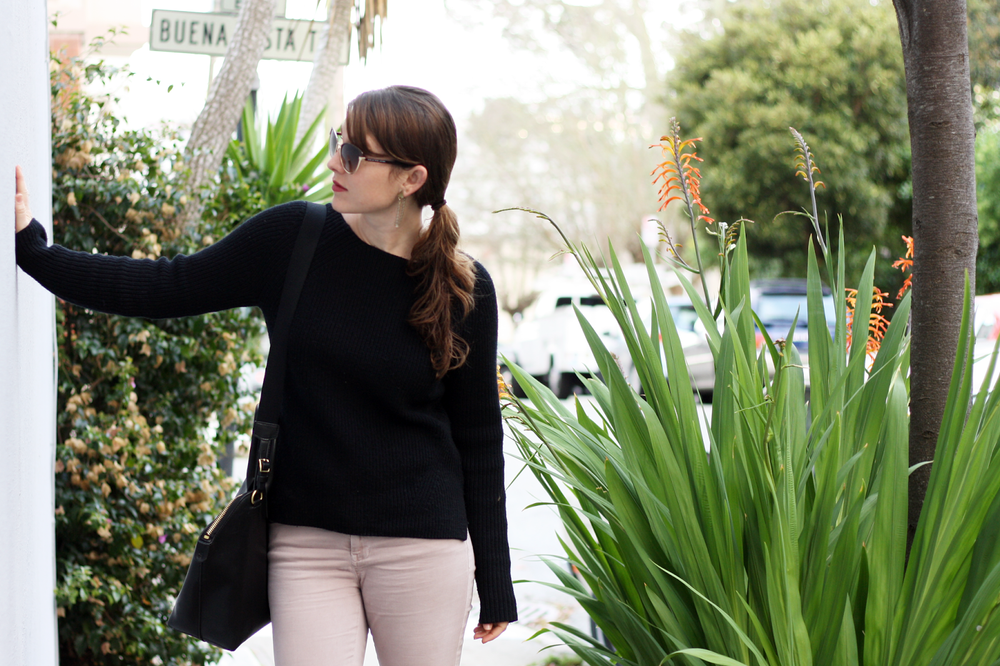
Among the Palms and Cherry Blossoms


* Note: while this bag is imported, Steven Allen has a great track record when it comes to using sustainable materials and American manufacturing. They're definitely I brand I can get behind -- and this Imogene tote might be the most beautifully constructed thing I own. Seriously, I saved up for this sucker, and it brings me more joy than I like to admit.
The Ethical Wardrobe, Part II: Who Made My Clothes?

But it certainly hasn't been a cakewalk. It took me three years to compile a modest list of ethical fashion brands. I've been floored by how expensive some sustainable options are. I've been frustrated with the elitism inherent in the ethical lexicon. And I still feel like a total weirdo every time I walk into a store and proceed to turn everything inside out to see where it was made.
In fact for many people cost, confusion, time restraints, and even embarrassment can be major barriers to making more ethical choices. But the wonderful thing about the ethical fashion movement is that it allows you to start small. You don't need to overhaul your closet or become a minimalist or spend $360 on a fair trade scarf (although don't let me discourage you, darling). All you need to do is start asking questions, one of the most important of which is...
Who made my clothes?
It’s simple, but putting a face to the things we interact with everyday – whether it’s the food we eat, the clothes we wear, or the devices we're attached to – can help keep us accountable. During my talk, I brought in several pieces of clothing and accessories from my own closet, which included Shinola, Horween Leather Company, Mata Traders, Everlane, Krochet Kids, and BCBG. I then asked the audience to think for a minute about who they thought might have made them. What were their lives like? How much were they paid? Did they get to design the garments themselves, take pride and ownership of their work? After a brief discussion I shared what I knew about each piece based on the information the companies provided:

The first five companies are all ones I consider to be ethical or sustainable for a variety of reasons. There are a lot of different ways to define "ethical" (which I'll go into in more detail later), but the Ethical Fashion Forum's definition is a good place to start. EFF describes a "triple bottom line" necessary to make a business truly sustainable: social, environmental, and commercial responsibility. In other words, truly ethical fashion goes beyond simply doing no harm; it actively reduces poverty, creates sustainable economies, lessens and counteracts environmental degradation, and meets an existing market demand. You can read more about it here.
The companies profiled above satisfy these parameters to varying degrees, but to put it even more simply, they allow me to answer that most-important question, who made my clothes? Because these companies have transparent supply chains, I know who made my favorite alpaca scarf, I know that she was fairly compensated for her work, and I even know that she plans to major in a technical field and own her own home. These are purchases I can feel good about, and companies that I am happy to support.
But these companies are the exception, not the rule. A lot of items in my closet come from companies like BCBG. You know, the one with the dramatic question mark; the one that reads UNKNOWN. I wish I could tell you that whoever made my favorite wool coat in China wasn't a slave laborer or under the age of 14, but all I can really do is make assumptions about what working conditions are like in these factories based on vague corporate social responsibly statements.
In some cases, working conditions might be fair, and even enable employees to support their families, rise from poverty, and live better lives than their parents. NPR's Planet Money Makes a T-Shirt has a beautifully nuanced video that follows garment workers in India and Columbia and illustrates how wildly wages, working conditions, and and social mobility can vary from country to country.
And then of course, we have Rena Plaza. Which makes all this not-knowing or kind-of knowing not ok.
And remember, ethical fashion is more than simply not doing harm, it's about making people's lives better. So even if a company claims it doesn't condone slave or child labor, or pollute the environment all that much, it's not inherently ethical. I'd rather know that my purchases are actively making the world just a little more fair.
So, who gets my money?
As Jess of Notes From a Thoughtful Life points out, there's no wrong or right way to approach ethical shopping. Which companies you decide to support will depend on the ethical issues you feel most strongly about. If you're vegan or vegetarian, you might want to focus on cruelty-free or animal-free products. If you're keen on bringing manufacturing back to the United States, you might want to buy American-made. If you're foremost an environmentalist, you'll probably prioritize brands that have zero-waste policies or minimal environmental impact. Ideally, an ethical fashion brand will have several ethical traits, but my focus had always been on humans (how can I make sure my purchases didn't hurt anyone along the way?). So I usually prioritize fair trade or made in the USA options over something that's simply vegan or "eco-friendly."
As I mentioned in my previous post, fashion is a big part of our identity, and inherently emotional. Clothes can mean joy, pride, celebration, dignity, and self-expression. They can mean enough money to feed your family, and prosperity for your community. They can also mean shame, struggle, abuse, even death. So when we vote with our dollars, let’s vote for joy.
I'll be following up with two more posts: one that explores the definition of "ethical" more deeply, and another that talks about how to make your sewing practice more sustainable. In the meantime, tell me about your own experiences with ethical shopping in the comments. What are the biggest hurdles you face when making more conscientious choices?
Scarf Weather


It may not be quite cold enough for a jacket and tights, but there's finally that Autumn nip in the air... and I'll take any excuse to break out my impossibly soft Krochet Kids scarf. Seriously, every time I wrap that alpaca wool around my neck, I want to curl up on the couch, drink a chai tea, and take a nap. Here's to lazy weekends, wood burning stoves, and dreams of winter. I'm ready.
Crafting an Ethical Wardrobe: the Button-Up Shirt
So as I round out my own professional wardrobe (still a work in progress), I want to share out some of my favorite brands, along with what I consider to be professional staples. I'll show you where to find these pieces in a range of prices, or — if you're one of those crafty types — how to make it yourself. So let's start at the top, with the button-up blouse.

It's pretty hard not to look sharp in a button-up. And depending on how trendy you go with it, this piece could potentially be in your wardrobe for decades. I prefer silk or a poly-blend to cotton, mostly because I hate ironing, but any variation on the button-up can look super polished tucked into a pencil skirt or with a pair of skinny slacks.
Buy it:
I love Everlane's button-ups, along with Alternative Apparel's more casual options. Hart of Haute's Greta top has a cute vintage vibe, and People Tree's Miranda Pocket blouse and Peggy Lace blouse both put a spin on the traditional cotton fare.
If you've got some bread to spare and want a true investment piece, try Steven Allen's cotton button-ups (made in USA), Trina Turk's Eilane top (made in California), Angel Chang's button-down (check out her commitment to growing rural economies in China), and Stella McCartney's Washed Cotton Poplin (read up on Stella's commitment to sustainability here).
And if the prices above gave you a mild heart attack, check out the blouse collections on Threadflip and Twice, all secondhand and many of them work-appropriate.
Make it:
Grainline studio's Archer button-up shirt is a true classic, suitable for a variety of fabrics weights including silk chiffon, silk crepe de chine, cotton shirting, and chambray. I love the angled cuffs and pleated back — so pretty!
Burda also carries a number of button-up styles, including this one with pleated pockets, and the Epaulette blouse, and Simplicity's "Amazing fit" shirt looks like it's highly-customizable at the bust (hooray!). Also, check out this great button-up tutorial on Etsy's blog.
A few words on fit:
I have a larger bust and broad shoulders, so it can be hard to find an off-the-rack button-up that fits. Although I haven't actually done this yet, I'd like to try Stacy and Clinton's advice and buy a size up, then have it custom-tailored. I'm also intrigued by designer Rochelle Behrens' "no gape technology" (if its promise holds true, is it worth $198? At least it's made in NYC?). In the meantime, I keep that gap closed with the magic of hem tape.
How do you style your favorite button-up? Any ethical options I missed?
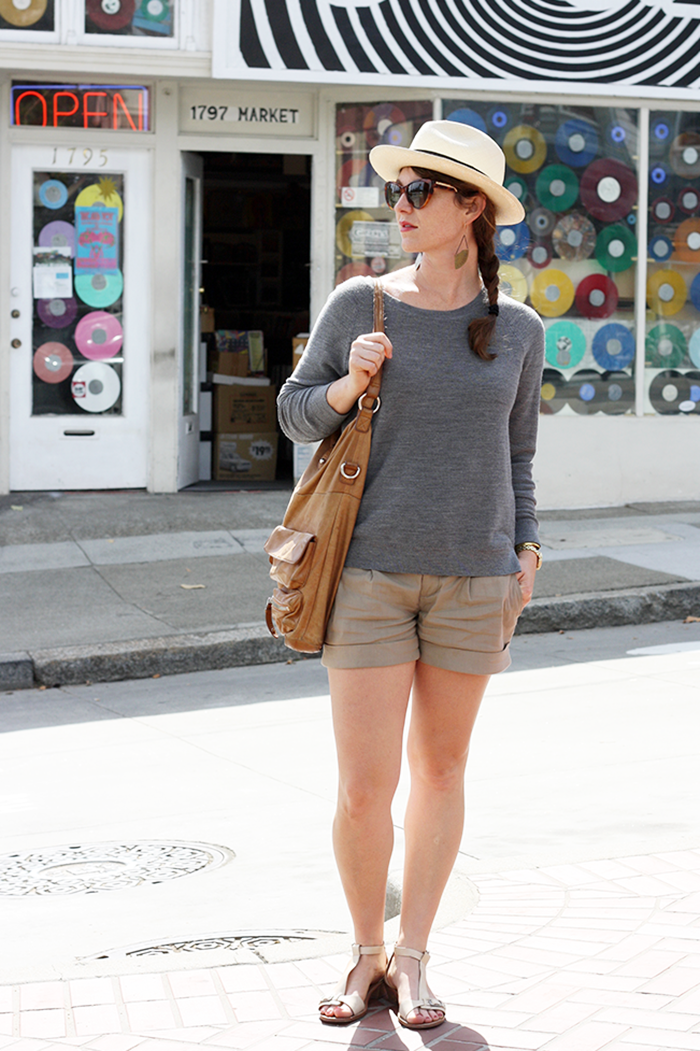
Groovin' on a Sunday afternoon


I'm keeping it simple this weekend with Everlane's Seed Stitch Raglan sweater, which arrived at my doorstep in under an hour through the company's 1-hour San Francisco delivery service. That, Grooves Vinyl, and these sunny Autumn days are just a few reasons to love our little city.
Everlane's Open Studio... and a Drink or Two

A couple of weeks ago, Jon and I had the pleasure of visiting Everlane's open studio, where we browsed through their men and women's basics and got a sneak peek at their Spring collection. Everlane's bright, minimalist space is a perfect reflection of their brand; like their neutral tees, button-ups, and sweaters, this crisp backdrop showcased the style of each attendee. Skinny jeans and animal-print clogs, cotton sweaters and red lipstick, rolled-up oxfords and ink -- this was the aesthetic of the day.
After a couple of cocktails courtesy of the event's stellar bartenders, we wandered over to The Homestead which (surprise) was nearly empty at 1pm on a Saturday. Rain, whiskey, a crochet beret, and a fleeting sense that we could live like this forever... it makes me want to wax poetic. How about some pictures instead?


Featured above is my much-loved Krochet Kids knit cap.
Conscientious Cashmere by Everlane


Introducing Everlane
As a counterbalance to the amount of floral I've been posting lately, I thought I'd show off the ready-for-work sweater I recently snagged from the ethical fashion lineEverlane. Unique among the other ethical companies I've researched, Everlane operates under a "radical transparency" model that urges customers to know their factories and question the true costs of the clothes they purchase. Everlane's website makes this easy by offering detailed profiles of each of their partner factories, from their sandal factory in Los Angeles to their cashmere factory in Dongguan, China. Developing personal relationships with the owners allows Everlane to closely monitor each factory's working conditions and overall integrity.
Made in China, and that's ok
Everlane is one of the only ethical companies I've found that carries elegant basics like crew neck sweaters, cardigans, and silk blouses. This is a big deal, because until now I've relied almost exclusively on J. Crew to complete my work wardrobe. Everlane has also inspired me to broaden my definition of what I consider ethical fashion. When I first began searching for ethical options, my criteria was limited to clothing that was fair trade or made in the USA, UK, Italy, or other "first world" country with stringent workplace standards. To be honest, I developed a mild disdain for anything with a "Made in China" label. This reaction (er, snobbery) wasn't entirely without warrant: many designer labels produce their clothes in China for a low cost in poor working conditions and mark their prices up wildly by the time they reach the consumer. "Made in China" has become synonymous with cheap and disposable, and many higher-end labels do their best to draw attention away from where their products are made, even if they do have strict workplace standards in place. This is a shame, because China has some of the most advanced machinery and talented garment workers in the world. There's a reason my vintage Coach bag has held up for so many years: it was made really well to begin with.
I support shopping and sourcing locally whenever possible, but it's short-sighted to ignore the talent and resources available overseas. It simply needs to be tapped responsibly, and I'm happy to support companies like Everlane that are committed to doing so.
Outfit details: Navy crewneck cashmere sweater by Everlane | Silk pan collar blouse, thrifted |Graham studded leather wrapby Gorjana (Made in USA) | Theory velvet skirt and leather bag via Crossroads