Chula Lane
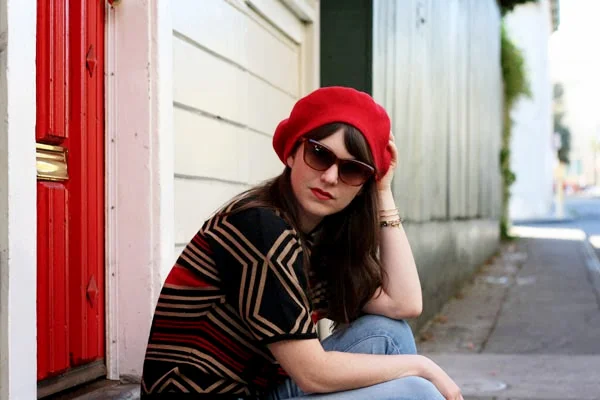


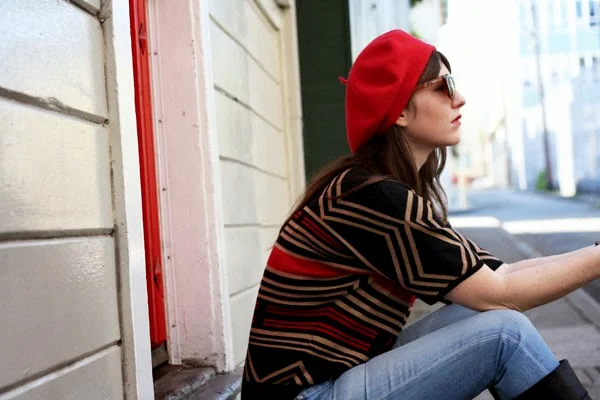
Thank you, resident of Chula Lane, for letting me use your font door and geraniums as a backdrop (you weren't home, so I'm assuming this was ok). Featured here are some of the most-loved pieces in my wardrobe, hailing from the good ol' USA and around the world:
Merino wool sweater from Pendleton's Portland Collection. Pendleton, the Oregon-based company with origins dating back to 1863, is bringing production back to the U.S. with its Portland Collection, a line of women's and men's apparel, accessories, and blankets designed and manufactured in its namesake city. And this sweater is simply magical; every time I put in on I swear I catch a whiff of wood burning stoves and hear echos of the Decemberists.
Krochet Kids alpaca scarf. Made in Peru by Fiorella Pereda, this Krochet Kids scarf kept me warm all through California's cold snap. Now, if we could just get some rain...
TOMS Kitty sunglasses in tortoise. So as to solidify my love of TOMS and its new business model, I finally bucked up and bought my first pair of fancy sunglasses. They're big, well crafted, and cooler than cool.
Cuff bracelet by Gorjana. My parents gave me this very special piece of jewelry for Christmas. It's the first piece I've owned by Gorjana, a socially conscious jewelry and accessories brand headquartered in Laguna Beach.
Adriano Goldschmeid jeans. Made in LA; I've had these jeans for over four years and they still look fantastic.
American Apparel red wool beret. Made in LA; one of my all-time favorite accessories.
Photos by Jonathan Meyer (husband, works for free).
Purple Haze: Colette Ginger Skirt in 60's-inspired Print


When I was a little kid growing up in the early 90’s and sporting bike shorts, LA Gears, and scrunchie socks, I was fairly certain that our generation had invented neon colors. I was even so presumptuous as to ask my dad what life was like before the invention of my then-favorite color: harlequin green. He promptly schooled me on the history of the neon palette, including its use in the psychedelic rock posters of the 60’s and 70’s, and his own airbrush art. My dad is the coolest.
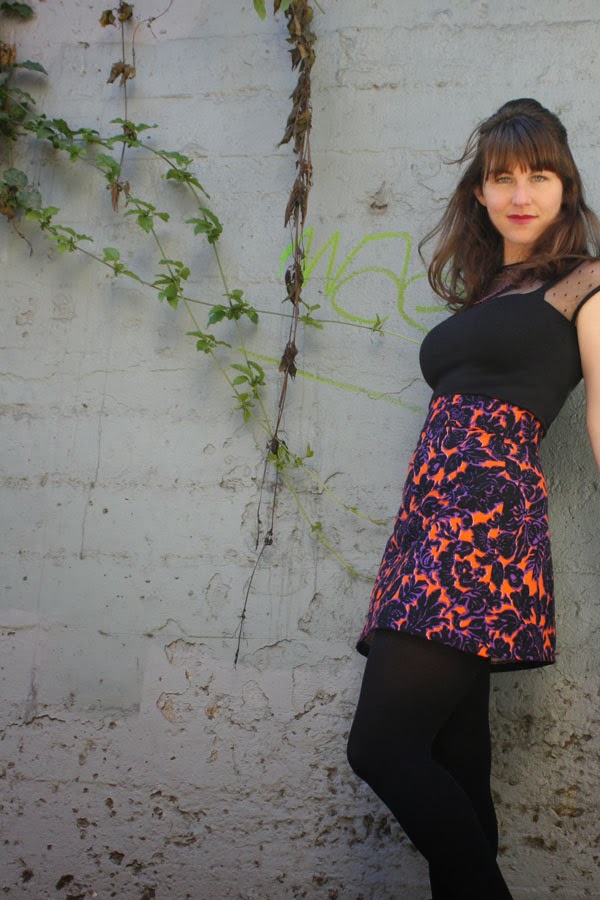
Fast forward 20+ years, and I am finally realizing my childhood dream of singing in a classic rock band, thanks to the folks at Blue Bear School of Music and some seriously talented band mates. For our showcase, I wanted to create a mini skirt in a bright 60’s pattern using Colette’s Ginger pattern – and in the process finally conquer that nemesis of an invisible zipper. I’m happy to report that I was successful on both fronts.
I found the neon orange, black and purple floral print at Britex (97% cotton; 3% lycra, made in Italy), and sewed the whole thing up in an evening. The fact that I invested in a proper invisible zipper foot (instead of the crappy plastic one I had on hand) made a world of difference. I probably only dropped the f-bomb five times the whole night! Progress.

How TOMS is Getting it Right
After owning a very durable, comfortable pair of their canvas loafers for over a year now, I can legitimately say I like TOMS' product, not just their mission. And now that the company is opening manufacturing centers in developing countries and using their strong market presence to promote other for-benefit brands, I'm also a fan of the way they do business. In my book, TOMS is getting it right in the ethical fashion world by:
1. Turning criticism into opportunity
TOMS debuted with a simple but novel business model: sell inexpensive canvas shoes and for each pair sold, donate a pair to a child in need. As TOMS' origin story describes, Blake Mycoski came up with this business idea when he traveled through some of the poorest villages in Argentina and noticed that most of the children there weren't wearing shoes. He then redesigned the traditional Argentine alpargata, marketed it to westerners, and in turn provided the world's poorest communities with footwear.
The problem was, the communities being targeted didn't just need shoes -- they needed jobs. Critics like Cheryl Davenport of Mission Measurement argued that TOMS' well-intentioned model was “little more than a short-term fix in a system in need of long-term, multi-faceted economic development, health, sanitation, and education solutions.” She pointed out that that TOMS’ success was hinged on western consumers’ need to “do good” without really taking the time to understand the needs of developing countries. If TOMS was to have a lasting impact on global poverty, she posed, it needed to invest in the communities it was supporting and provide viable economic opportunities -- to " create a solution, not a band-aid."
In turn, TOMS focused their efforts on producing shoes in the countries that they support. Currently, they have factories Ethiopia, Kenya, Argentina, and China, with the goal of producing one third of their shoes in the regions where they give them within three years. And in September at the Clinton Global Initiative Annual Meeting in New York City, Mycoskie announced that TOMS will open a manufacturing center in Haiti in January 2014 as a part of an ongoing partnership with the Haiti Artist Collective.
In Haiti, TOMShas made a five-year commitment to produce millions of shoes in a 10,000-square-foot factory in Port-au-Prinace to help foster a "responsible, sustainable" Haitian shoe industry. “By making such a strong commitment and business investment," Mycoskie says, "we hope to inspire other companies in the fashion and footwear industries to follow suit.”
It will be interesting to see what impact such investment has on the economies of these countries. If it does in fact create a significant difference, TOMS can serve as a model for other like-minded companies.
2. Using their influence to grown an industry
Though a combination of excellent marketing, ample press, and probably a good amount of luck, TOMS became a household name in both fringe and mainstream markets. And with the recent launch of TOMS Marketplace, they are using their influence to promote other brands with similar social purposes.
As of its launch last week, the marketplace features over 200 products from more than 30 companies and charities. Krochet Kids, a knitwear line that provides women in northern Uganda and Peru with a pathway out of poverty, is among the brands available. As a recent New York Times feature reported, TOMS chose which brands to carry based on a number of different for-benefit traits – from the “one for one” model they pioneered to companies like Krochet Kids that help build community infrastructure. As Mycoskie described, the real question was “'does this company really have a mission of improving people’s lives built into its business model?’”
It’s a standard that all ethical companies must be held to. More than being socially conscious, for-benefit companies must have the soul of a charity and the savvy of a for-profit. No easy feat, but I’m excited to see what TOMS and their brethren will accomplish in the coming years.
Made in Maui: Love from the Islands
After the horror of hurricane Sandy and the dreary drizzle here in the Bay Area (I know, tiny violin), I thought it would be fitting to revive this long-hibernating blog with a little tropical escapism.
My now-official-partner-in-crime and I spent our honeymoon on the island of Maui enjoying spectacular sunsets, remote winding highways, tranquil beaches, and boutique-perusing (ok, the last one might have been more of a solo activity). Here's a quick look at some of the gems the island had to offer:
Shopping in Paia, Maui
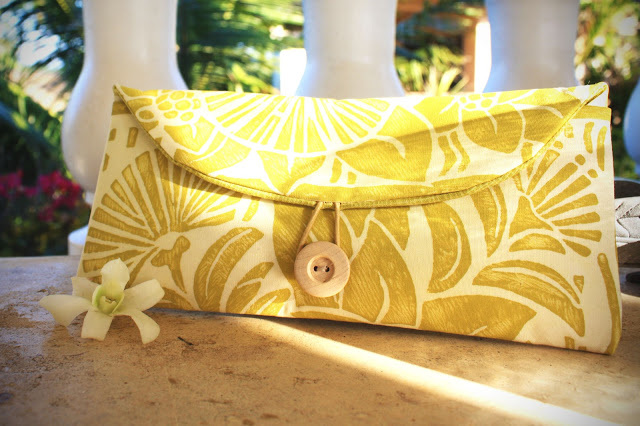
In this laid-back little beach town I found Biasa Rose, a boutique with a great selection of eco- and socially-conscious brands and handmade goods (there's also a second-hand section hiding in the back). After finally breaking down and deciding to buy a pair of TOMS, I picked up this lovely hand-printed clutch by Palapala Designs:
And in spite being completely unnecessary in Maui's balmy climate, this soft and cozy cream-colored scarf knit by Fiorella of Krochet Kids International caught my eye.
I love the modelbehind the company, which provides women in northern Uganda and Peru with employment, training, and education to offer a pathway out of poverty. The website includes a "meet the ladies" section with a profile of each artist, and encourages you to write a thank-you note to the woman who created your hat or scarf. It may seem simple, but enabling that personal connection to a product is pretty powerful, making each accessory so much more meaningful than something generated en masse. I know I'll be thinking about Fiorella (and the presumably adorable alpaca who provided the wool) when donning my scarf on those chilly San Francisco mornings.
Around Town: Snapshots