
The Ethical Wardrobe, Part II: Who Made My Clothes?

But it certainly hasn't been a cakewalk. It took me three years to compile a modest list of ethical fashion brands. I've been floored by how expensive some sustainable options are. I've been frustrated with the elitism inherent in the ethical lexicon. And I still feel like a total weirdo every time I walk into a store and proceed to turn everything inside out to see where it was made.
In fact for many people cost, confusion, time restraints, and even embarrassment can be major barriers to making more ethical choices. But the wonderful thing about the ethical fashion movement is that it allows you to start small. You don't need to overhaul your closet or become a minimalist or spend $360 on a fair trade scarf (although don't let me discourage you, darling). All you need to do is start asking questions, one of the most important of which is...
Who made my clothes?
It’s simple, but putting a face to the things we interact with everyday – whether it’s the food we eat, the clothes we wear, or the devices we're attached to – can help keep us accountable. During my talk, I brought in several pieces of clothing and accessories from my own closet, which included Shinola, Horween Leather Company, Mata Traders, Everlane, Krochet Kids, and BCBG. I then asked the audience to think for a minute about who they thought might have made them. What were their lives like? How much were they paid? Did they get to design the garments themselves, take pride and ownership of their work? After a brief discussion I shared what I knew about each piece based on the information the companies provided:

The first five companies are all ones I consider to be ethical or sustainable for a variety of reasons. There are a lot of different ways to define "ethical" (which I'll go into in more detail later), but the Ethical Fashion Forum's definition is a good place to start. EFF describes a "triple bottom line" necessary to make a business truly sustainable: social, environmental, and commercial responsibility. In other words, truly ethical fashion goes beyond simply doing no harm; it actively reduces poverty, creates sustainable economies, lessens and counteracts environmental degradation, and meets an existing market demand. You can read more about it here.
The companies profiled above satisfy these parameters to varying degrees, but to put it even more simply, they allow me to answer that most-important question, who made my clothes? Because these companies have transparent supply chains, I know who made my favorite alpaca scarf, I know that she was fairly compensated for her work, and I even know that she plans to major in a technical field and own her own home. These are purchases I can feel good about, and companies that I am happy to support.
But these companies are the exception, not the rule. A lot of items in my closet come from companies like BCBG. You know, the one with the dramatic question mark; the one that reads UNKNOWN. I wish I could tell you that whoever made my favorite wool coat in China wasn't a slave laborer or under the age of 14, but all I can really do is make assumptions about what working conditions are like in these factories based on vague corporate social responsibly statements.
In some cases, working conditions might be fair, and even enable employees to support their families, rise from poverty, and live better lives than their parents. NPR's Planet Money Makes a T-Shirt has a beautifully nuanced video that follows garment workers in India and Columbia and illustrates how wildly wages, working conditions, and and social mobility can vary from country to country.
And then of course, we have Rena Plaza. Which makes all this not-knowing or kind-of knowing not ok.
And remember, ethical fashion is more than simply not doing harm, it's about making people's lives better. So even if a company claims it doesn't condone slave or child labor, or pollute the environment all that much, it's not inherently ethical. I'd rather know that my purchases are actively making the world just a little more fair.
So, who gets my money?
As Jess of Notes From a Thoughtful Life points out, there's no wrong or right way to approach ethical shopping. Which companies you decide to support will depend on the ethical issues you feel most strongly about. If you're vegan or vegetarian, you might want to focus on cruelty-free or animal-free products. If you're keen on bringing manufacturing back to the United States, you might want to buy American-made. If you're foremost an environmentalist, you'll probably prioritize brands that have zero-waste policies or minimal environmental impact. Ideally, an ethical fashion brand will have several ethical traits, but my focus had always been on humans (how can I make sure my purchases didn't hurt anyone along the way?). So I usually prioritize fair trade or made in the USA options over something that's simply vegan or "eco-friendly."
As I mentioned in my previous post, fashion is a big part of our identity, and inherently emotional. Clothes can mean joy, pride, celebration, dignity, and self-expression. They can mean enough money to feed your family, and prosperity for your community. They can also mean shame, struggle, abuse, even death. So when we vote with our dollars, let’s vote for joy.
I'll be following up with two more posts: one that explores the definition of "ethical" more deeply, and another that talks about how to make your sewing practice more sustainable. In the meantime, tell me about your own experiences with ethical shopping in the comments. What are the biggest hurdles you face when making more conscientious choices?
The Ethical Wardrobe, Part I: It's Complicated

As my mom would say, I was being a bit of a Debbie Downer about my Britex talk last week. But now that the sting of not being perfect has worn off, I’d like to share out some of the content. There’s a lot of it – more than I was able to get through on Saturday – so I’m going to break it up into a few posts and include some extra links and resources. Without further ado, then, here’s my schpeal on crafting an ethical wardrobe.
Fashion, Emotion, and Cold Hard Facts
I began my talk by asking the audience to share some of the emotions they typically felt while shopping. Responses included “guilt,” “frustration,” “score!” “having fun,” “frivolous,” “annoyance”…and more “guilt.” If you're reading this now, take a minute to think about it. Do you love shopping? Does it fill you with anxiety? Maybe a little bit of both?
Although our ages, believes, incomes, and shopping habits may vary wildly, there are two things that we and roughly every other person on the planet do every day: eat, and get dressed. And yet for something we do every day, the choice of what to wear and what to eat can be pretty mentally and emotionally exhausting. When I asked my audience to think about some of the emotions they had towards shopping, many were negative. Why is that?
Well, clothes are complicated. They’re one of the most obvious expressions of our personality, tastes, lifestyle, even social status. We spend hours hunting for them, making them, taking care of them, talking about them, loving them, hating them. And advertisers spend billions of dollars every year trying to get us to buy them.
Clothes carry an emotional weight for all of us: that adrenaline rush you get when scoring a designer label for a third of the price; the pride you feel when designing and sewing your own clothes; the shame you may have felt when you couldn’t afford to dress like your classmates, neighbors, or colleagues.
A lot of our identity, and increasingly our sense of morality, is wrapped up in what we wear. And that’s a lot of pressure! We now have access to an overwhelming number of facts around global poverty, global warming, and the effects that fast fashion is having on people and our planet. I can go online and find some pretty sobering statistics about all of this stuff within in minutes, like the fact that:
- If each person owned only one pair of pants, one shirt, and one jacket, that would be 21 billion articles of clothing. If you were to count each of those, one per second, it would take nearly 672 years. And I, for one, own far more than three articles of clothing.
- In fact, the average American family spends about $1,700 a year on clothes.
- The average American also trashes about 65 pounds of textiles per year.
- In contrast, we know that 2.4 billion people worldwide live on less than 2.00 a day.
- The average wage of a garment worker in India is $68 – 100/ month. That would be about $200 – 300/ month in the U.S. when you adjust for cost of living differences.
- There are over 27 million modern-day slaves worldwide, many of whom support the textile or cotton industries.
- Finally, if everyone consumed at the rate of the U.S., we would need 3 to 5 planets.
I first started learning about the effects fast fashion and the full scope of global inequality in college. The thing is, while these stats were pretty shocking, none of them ever inspired the “aha” moment – or the action – that I hoped they would. I bought my sweatshop free sneakers and fair trade coffee, and nagged my friends about how they should too (you can imagine how fun I was at parties). But I wasn’t really sure why, other than it seemed like the right thing to do.
Then in 2010, my now-husband and I took a trip to Cairo, Egypt. This was a year before the Egyptian revolution, so the political and economic tension was pretty palpable. We saw the pyramids. We took a Nile cruise. But for me, the most memorable part of the trip was a visit to a carpet factory outside the city. The owner gave us a tour of the gallery, proudly showed off the expertly woven rugs, and then asked if we’d like to meet the people who made them. So we went downstairs.
The carpet makers? All children, all under twelve. Smiling sweetly, but working. And that really was when it hit me. When all of those facts I’d been collecting over the years were ignited by a purely emotional experience. I realized that if I’d been born into different circumstances – or even born in the U.S. a century ago – that could have been me. It could have been one of my students. It could have been my child.
I have no idea what went on behind the scenes at this carpet factory, or whether the children really attended school like the owner told us. But the bottom line is that this is a reality for 215 million of the world’s children. That’s 1 in 7. And child labor is only one of the many global injustices that take place in the name of fashion – so that I can buy that $14 linen skirt for so perfect for Cairo in the summer.
This experience didn’t inspire me to go out and buy every piece of fair trade clothing I could get my hands on. It didn’t even inspire me take political action (mostly because I wasn’t sure where to start). But it did start me on a journey toward becoming a more conscientious shopper. And a year after Cairo, I started this blog.
Although my personal fight against fast fashion can feel small – even frivolous – at times, it’s part of a movement that is gaining more and more traction. A movement that starts with the question: Who made my clothes?
Conscientious Cashmere by Everlane


Introducing Everlane
As a counterbalance to the amount of floral I've been posting lately, I thought I'd show off the ready-for-work sweater I recently snagged from the ethical fashion lineEverlane. Unique among the other ethical companies I've researched, Everlane operates under a "radical transparency" model that urges customers to know their factories and question the true costs of the clothes they purchase. Everlane's website makes this easy by offering detailed profiles of each of their partner factories, from their sandal factory in Los Angeles to their cashmere factory in Dongguan, China. Developing personal relationships with the owners allows Everlane to closely monitor each factory's working conditions and overall integrity.
Made in China, and that's ok
Everlane is one of the only ethical companies I've found that carries elegant basics like crew neck sweaters, cardigans, and silk blouses. This is a big deal, because until now I've relied almost exclusively on J. Crew to complete my work wardrobe. Everlane has also inspired me to broaden my definition of what I consider ethical fashion. When I first began searching for ethical options, my criteria was limited to clothing that was fair trade or made in the USA, UK, Italy, or other "first world" country with stringent workplace standards. To be honest, I developed a mild disdain for anything with a "Made in China" label. This reaction (er, snobbery) wasn't entirely without warrant: many designer labels produce their clothes in China for a low cost in poor working conditions and mark their prices up wildly by the time they reach the consumer. "Made in China" has become synonymous with cheap and disposable, and many higher-end labels do their best to draw attention away from where their products are made, even if they do have strict workplace standards in place. This is a shame, because China has some of the most advanced machinery and talented garment workers in the world. There's a reason my vintage Coach bag has held up for so many years: it was made really well to begin with.
I support shopping and sourcing locally whenever possible, but it's short-sighted to ignore the talent and resources available overseas. It simply needs to be tapped responsibly, and I'm happy to support companies like Everlane that are committed to doing so.
Outfit details: Navy crewneck cashmere sweater by Everlane | Silk pan collar blouse, thrifted |Graham studded leather wrapby Gorjana (Made in USA) | Theory velvet skirt and leather bag via Crossroads
Stocking Stuffers with Soul

Visit IFB to browse through other bloggers' holiday gift guides.
ASOS to the Rescue: The Green Room
For a while now I've been lamenting the fact that I couldn't find a US-based shopping site that sourced a wide range of ethical clothing that I would actually wear. Somehow I managed to miss ASOS's Green Room, which does just that (although ASOS is based in the UK, it has a US site allows users to browse without worrying about currency conversion). Launched in 2010, the Green Room is a section of ASOS's larger site that carries organic and fair trade brands like People Tree as well as a number of Made in the UK and Made in the USA brands like The Cambridge Satchel Company and Gloverall. Although they can be pricey, all of the items in the Green Room fall into one or more ethical categories, which the section conveniently describes in an interactive glossary.
Definitely worth checking out as you make your way through your holiday shopping list.
Made in Maui: Love from the Islands
After the horror of hurricane Sandy and the dreary drizzle here in the Bay Area (I know, tiny violin), I thought it would be fitting to revive this long-hibernating blog with a little tropical escapism.
My now-official-partner-in-crime and I spent our honeymoon on the island of Maui enjoying spectacular sunsets, remote winding highways, tranquil beaches, and boutique-perusing (ok, the last one might have been more of a solo activity). Here's a quick look at some of the gems the island had to offer:
Shopping in Paia, Maui
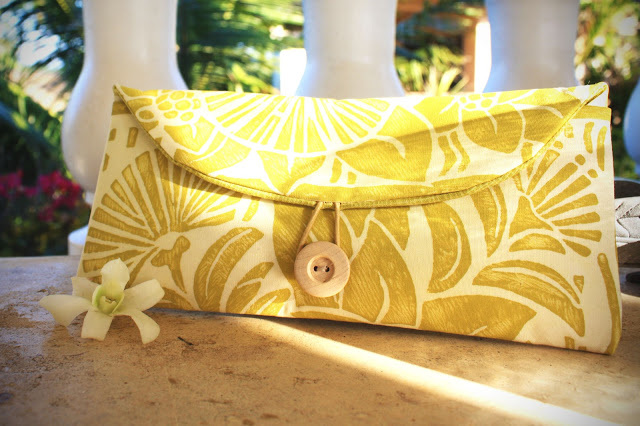
In this laid-back little beach town I found Biasa Rose, a boutique with a great selection of eco- and socially-conscious brands and handmade goods (there's also a second-hand section hiding in the back). After finally breaking down and deciding to buy a pair of TOMS, I picked up this lovely hand-printed clutch by Palapala Designs:
And in spite being completely unnecessary in Maui's balmy climate, this soft and cozy cream-colored scarf knit by Fiorella of Krochet Kids International caught my eye.
I love the modelbehind the company, which provides women in northern Uganda and Peru with employment, training, and education to offer a pathway out of poverty. The website includes a "meet the ladies" section with a profile of each artist, and encourages you to write a thank-you note to the woman who created your hat or scarf. It may seem simple, but enabling that personal connection to a product is pretty powerful, making each accessory so much more meaningful than something generated en masse. I know I'll be thinking about Fiorella (and the presumably adorable alpaca who provided the wool) when donning my scarf on those chilly San Francisco mornings.
Around Town: Snapshots


Engagement Photo Time!
1. Some of San Francisco's Balmy Alley murals (I like the horse one the best)
2. People Tree's Elisa Wrap Dress (100% fair trade organic cotton, fits great!)
3. Racer Five IPA (in honor of one of our first dates)


Put a Belt on It.
The Andean Collection
Even though I am a total sucker for Anthropologie's whimsical styling, I've been hesitant to shop there, considering they provide very little public information on their labor practices.
That said, I had a $20 gift card to blow this weekend, so I made a trip to Anthro’s downtown store and b-lined it to the sale rack. What I found there was this lovely fair trade belt from The Andean Collection.
The mission of the Andean Collection is similar to that of most fair trade companies: empower impoverished communities by giving local, talented artisans access to the global market. I'm glad to see that the buyers at Anthro are making efforts to participate in fair trade practices. Even if it's only a belt here and a necklace there, it's certainly a start.
Coincidentally, I’m an adherent of the “put a belt on it” philosophy—it’s an easy way to add a waist to an otherwise frumpy blouse, tunic, or dress. I know some ladies can rock the oversized-blouse look, but I usually end up looking like I’m wearing a muu muu. Not good. So I will continue to add to my collection of belts, and am glad to be able to do so fair trade style.

Ethical Shopping Lowdown (so far)

I Wanna Wanna Be/ Sweatshop Free

Keep in mind, is a fair ammount of sweatshop free clothing online, and National Green Pages has a listing of over 100 clothing companies that are organic, sustainable, and/or use fair labor practices. Problem is, most of them look like this:


There may have been a brief moment in college when I would have considered the latter, but I don't particularly want to scream to the world “NO ANIMALS OR HUMANS WERE HARMED IN THE MAKING OF THIS GARMENT.” I would rather look classic, professional, and stylish while coincidentally wearing responsible clothing. I’m not a huge American Apparel fan, for reasons I’ll detail below, but I do realize that they’re on to a good thing. I also realize that Europe is way ahead of the curve when it comes to such things (unfortunately, it can be hard to find these brands in/ have them shipped to the US).

Cute!